
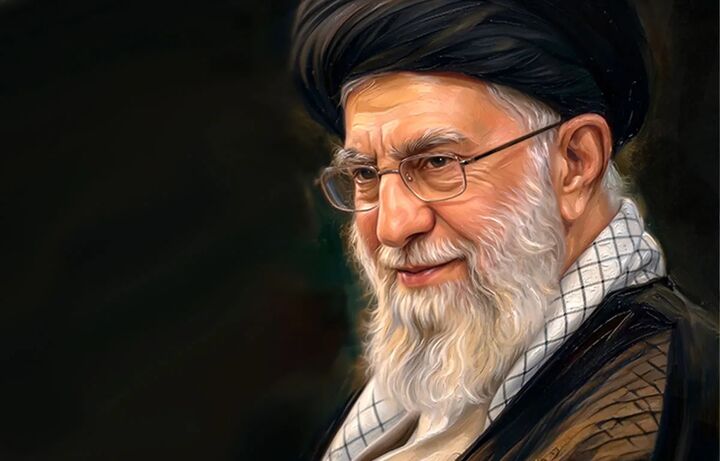
Bazaar: Today, the 15th of Khordad, and indeed the past two days, the world witnessed a scene in Tehran that has unraveled the strategic calculations of Western think tanks. The massive and stunning turnout of the people at the funeral of the martyred leader of Iran, Ayatollah Seyyed Ali Khamenei, is not merely a ritualistic ceremony; it is a raw manifestation of Iran as a “civilization-state” that has stood firm against the tide of globalization. This event represents the unbreakable bond between the nation and its fundamental values—an “authority rooted in origins”—and has cast a deep fear into the hearts of the architects of the New World Order and the Zionist monster.
The Grandeur of Presence: Beyond Political Mourning
When speaking of the unprecedented population in world history at the funeral of a high-ranking leader, Western reductionist analyses—which attempt to dismiss it as “state-organized”—clash with the hard wall of sociological reality. Today, Tehran is not just a political capital, but the beating heart of a millennia-old civilization where history and culture are inextricably intertwined. This epic presence is not the product of a single night; it is the culmination of decades of faith-based, cultural, and national bonds woven into the fabric of Iranian society. When millions, regardless of party affiliation or political leanings, stand shoulder to shoulder to pay tribute to a leader who symbolized independence and resistance against external onslaughts, a clear message is sent to the world: Iran is a “civilization-state” whose political borders deeply overlap with its cultural boundaries. Based on modern indicators of social cohesion, the level of public participation witnessed in Tehran today demonstrates a high coefficient of ideological and national penetration. This crowd, as a single entity, not only cements the country’s internal authority but, acting as a civilizational deterrent, invalidates any notion of “internal collapse”—a scenario that think tanks in London, Washington, and Tel Aviv have been investing in for decades.
Iran as a Dam Against Uniform Globalization
Why does the West fear such scenes? The answer lies in one word: “Authenticity.” The globalization project, initiated decades ago by the Western power bloc, had no aim other than cultural homogenization, the destruction of the family unit, the weakening of national sovereignty, and the promotion of extreme individualism. In this model, “client” countries must sacrifice their identity at the altar of consumerism and Western secular values. However, by emphasizing its nature as a “civilization-state,” Iran became a major obstacle to this project. For decades, the late leader of Iran stood as a symbol of this strategic resistance, emphasizing the preservation of the family nucleus, the sanctity of religion, and intellectual and political independence. The scale of today’s public presence is a resounding “no” to the liberal-democratic dictatorship that seeks to forcibly impose its behavioral models on other nations. The West’s fear is not of Iran’s military power—which is a separate matter—but of the Iranian “way of life” that still refuses to be digested by the stomach of globalization. When millions come today to bid farewell to someone who embodied the “rejection of hegemony,” it means that this message of resistance has permeated not just in word, but into the very soul of society. This is an absolute defeat for theories that viewed Iran as an “isolated” country; for today, this isolation has been interpreted as “identity self-sufficiency.”
Steadfast Pillars: Civilization, Faith, and National Pride
To understand the power of this historic funeral, one must look at the underlying pillars of Iranian society. The first pillar is “civilizational history.” Iranians today are heirs to an ancient collective memory that has preserved its identity even against the most formidable invasions of history. The fusion of this history with “firm faith” in religious teachings has created an element incomprehensible to Western secularism. Westerners have always tried to marginalize religion in individual life, but Iran has brought religion into the “text of political and social life.” Statistics show that despite economic pressures and extensive media propaganda, adherence to “family” and “religious institutions” in Iran remains among the highest in the world. This cohesion is the same element that has kept the people united under difficult conditions of sanctions and threats. The third pillar is “national pride.” In an era where nation-states across the world are being weakened and fractured, Iran has managed to redefine its “national identity” in an inseparable bond with sustainable security. The massive crowd seen in the streets of Tehran today is a blend of different generations; from youth influenced by the digital age to the elderly who witnessed the revolution. This generational diversity shows that this “civilization-state” possesses continuous reproduction and revitalizes itself with every generation.
Why is the West Powerless Against this “Soft Power”?
The West’s fear of the phenomenon we are witnessing in Tehran today has psychological and strategic roots. The West views power through “coercive tools” (political, military, financial), but Iran has proven over the years that it possesses power beyond these: “mobilization power.” When a political system can bring millions to the streets without coercion, based solely on emotional and belief-based bonds, it means “political legitimacy” still functions as a determining factor. Western media outlets, faced with this volume of public fervor, fall into two categories: they either boycott it or attempt to minimize it through reductionist analyses. But why are they so agitated? Because they know this level of solidarity does not just mean the continuity of a political structure; it means the failure of their “reverse engineering.” They spent decades trying to create distance between the people and the leadership, designed sanctions to erode the people’s livelihoods, and attempted to collapse the collective psyche through hybrid warfare. But the people’s presence today is a definitive answer to all these strategies. This ceremony is not a “show of force,” but a “confirmation of authority” that tells the world the project to weaken Iran has hit a dead end.
The “Civilization-State” vs. Worn-out “Nation-States”
In classical political literature, the “nation-state” is built upon modern social contracts, whereas the “civilization-state” is built upon the pillars of history, language, religion, and culture, extending beyond mere paper contracts. Iran operates according to this second model. While many countries in the region or the world are embroiled in identity crises or separatism, Iran has managed to stand against storms with unparalleled integrity. This civilizational feature has meant that even when the political system faces a challenge, the totality of “state” and “nation” remains intertwined. The crowd in Tehran today is a manifestation of this endurance. In sociological analyses, this phenomenon is called “organic solidarity”; where components of society become unified not because of government laws, but because of deep value-based bonds. The West, itself struggling with social disintegration following the decline of the family and the weakening of traditional values, cannot comprehend how a country can remain loyal to its roots in the age of globalization. This is the “paradox for the West” and the “synthesis for Iran,” the primary factor of their fear; for a united Iran is not just a global player, but a model for other nations weary of imposed globalization.
Future Outlook: Why Deeming this Grandeur Insignificant is a Strategic Error
Ultimately, one must ask: Who is victorious? Those who rely on destruction and chaos, or those who stand on the preservation of authenticity and civilizational ties? The answer lies in the pages of history yet to be written. The West, by imagining it could bring this civilization to its knees through “symbol destruction” or “economic pressure,” has committed a strategic error. Today’s ceremony demonstrated that leadership in Iran is not an individual; it is a “discourse” that has multiplied in the souls of millions. For the architects of globalization, witnessing this volume of unity is a nightmare that disrupts all their “regime change” calculations. This ceremony is a turning point in contemporary world history. If until yesterday the West imagined it could dissolve the Iranian identity by relying on modern tools, today it saw with its own eyes that this identity remains firmer than ever. Iran, as a “civilization-state” backed by this million-strong solidarity, will not surrender; rather, it is preparing itself for a new chapter of civilizational authority. While their project against this grandeur appears pathetic and groundless, the future belongs to nations rooted in their own soil and steadfast in their faith. This funeral is not an end, but a beginning for the world’s proper understanding of the unparalleled power of Iran’s civilization.











نظر شما